Field & Stream Mens True Pursuit Insulated Hunting Jacket Reviews
This browser is no longer supported.
Upgrade to Microsoft Edge to take advantage of the latest features, security updates, and technical back up.
Types of fields and field information
This topic applies to Dynamics 365 Customer Engagement (on-premises). For the Power Apps version of this topic, run into: Types of columns
Types of fields
The following tabular array contains information almost the field types bachelor.
| Field type | Clarification | Bachelor field data blazon |
|---|---|---|
| Simple field | Contains data that is not based on a formula. | Single Line of Text, Pick Gear up, Two Options, Image, Whole Number, Floating Point Number, Decimal Number, Currency, Multiple Lines of Text, Appointment and Time, Lookup |
| Calculated field | Contains calculations that utilize fields from the current entity or related parent entities. | Unmarried Line of Text, Option Set, Two Options, Whole Number, Decimal Number, Currency, Date and Time |
| Rollup field | Contains an aggregate value computed from the records related to a record, or a value computed over a hierarchy. | Whole Number, Decimal Number, Currency, Engagement and Time |
The following table contains information about the field data types.
| Field data type | Clarification |
|---|---|
| Single Line of Text | This field can contain upwardly to 4,000 text characters. You tin gear up the maximum length to be less than this. This field has several format options that will change the presentation of the text. These options are Electronic mail, Text, Text Surface area, URL, Ticker Symbol, and Phone. More data: More information: Unmarried line of text format options |
| Multiple Lines of Text | This field can contain up to 1,048,576 text characters. You tin set the maximum length to be less than this. When you add together this field to a class, you can specify the size of the field. |
| Option Set | This field provides a gear up of options. Each pick has a number value and characterization. When added to a class, this field displays a control for users to select but 1 option. When this field is displayed in Advanced Find, users tin employ a picklist control to select multiple options to include in their search criteria. You tin ascertain a single, global option set and configure Selection Set fields to use that single set of options. More information: More information: Creating and editing global option sets |
| MultiSelect Pick Set | This field provides a set of options, where multiple options can be selected. When added to a form, this field uses a control for users to select multiple options. When this field is displayed in Advanced Observe, users tin select multiple options from the list to include in their search criteria. You tin define a single global pick set and configure MultiSelect Option Ready fields to use that single set of options. More data: More data: Creating and editing global pick sets |
| Two Options | This field provides 2 options. Each option has a number value of 0 or i corresponding to a false or true value. Each choice too has a label and so that true or faux values can exist represented every bit "Yes" and "No", "Hot" and "Cold", "On" and "Off" or any pair of labels you want to display. Ii option fields don't provide format options at the field level. But when you add together one to the class you tin cull to display them as radio buttons, a check box, or a select list. |
| Status | A organization field that has options that by and large represent to active and inactive condition. Some arrangement attributes have boosted options, merely all custom attributes have only Active and Inactive status options. Y'all can also include custom state transitions to control which status options are available for certain entities. More information: Define condition reason transitions |
| Condition Reason | A arrangement field that has options that provide additional item virtually the Status field. Each choice is associated with one of the available Status options. Y'all can add and edit the options. |
| Whole Number | Integers with a value between -2,147,483,648 and ii,147,483,647 can exist in this field. You can restrict the maximum or minimum values in this range. This field has format options None, Duration, Time Zone, and Language that alter depending on how the field is presented. More than information: Whole number format options |
| Floating Betoken Number | Upwards to 5 decimal points of precision can exist used for values between -100,000,000,000 and 100,000,000,000 can be in this field. You can specify the level of precision and the maximum and minimum values. More information: Using the right blazon of number |
| Decimal Number | Up to 10 decimal points of precision tin can be used for values between -100,000,000,000 and 100,000,000,000 tin be in this field. You can specify the level of precision and the maximum and minimum values. More information: Using the right type of number |
| Currency | Monetary values between -922,337,203,685,477 and 922,337,203,685,477 tin can be in this field. You tin gear up a level of precision or cull to base the precision on a specific currency or a unmarried standard precision used by the arrangement. More information: Using Currency Fields |
| Date and Fourth dimension | This field has format options to display Appointment Only or Appointment and Time. |
| Image | Each entity that supports images tin have one image field. When an entity has an image field, it tin be configured to display the image for the record in the application. More information: Prototype fields |
| Lookup | A field that allows setting a reference to a single record of a specific type of entity. Some system lookup fields behave differently. More than data: Different types of lookups |
| Owner | A system lookup field that references the user or squad that is assigned a user or squad owned entity record. |
| Unique Identifier | A organisation field stores a globally unique identifier (GUID) value for each record. |
| Customer | A lookup field that you can use to specify a client, which tin exist an account or contact. |
MultiSelect Option Set
You can customize forms (primary, quick create, and quick view) and email templates by adding multi-select fields. When you add a Multi-Select Option Set up field, yous can specify multiple values that volition exist available for users to select. When users fill out the class they can select 1, multiple, or all the values displayed in a drop-down listing.
For case, if an organisation operates in multiple areas or countries, you can include multiple locations or countries in an 'Area of operation' field. A user can then select ane or more locations from the list of available values.
Multi-select option sets can be used with read-but grids, editable grids, and most forms. Multi-select pick sets tin't be used with:
- Workflows, business procedure flows, actions, dialogs, business concern rules, charts, rollup fields, or calculated fields.
- Reports, SLA, or routing rules.
Multi-select fields are supported in the following types of forms:
| Form Type | Availability |
|---|---|
| Turbo class | Yes |
| Refresh class | Read-only (field will bachelor merely cannot be edited) |
| Legacy form | No |
| Bulk Edit class | No |
You can utilize global option sets that are defined in your system to configure values for the multi-select option sets. For Use Existing Pick Set up, select Aye, and then choose an option set from the Option Set drib-downwardly list. Also, you can perform the following activity on the global option set up without leaving the field creation dialog box:
-
Select Edit to edit the global option set.
Note
Yous can only edit a global option set if Customizable is True.
-
Select New to create a global option set.

More information: More than data: Creating and editing global choice sets
Customer field
In previous releases of Dynamics 365 Client Date (on-premises), several out-of-the-box entities such as the Instance, Lead, and Opportunity entities, included a special kind of lookup field that represented a customer. Using this lookup field you lot could cull between 2 entities: Account or Contact. With this new adequacy, you tin add the Client field to whatever organisation or custom entity. You can utilize the Client field in more entities to track the client'due south information in the same way you've used the Customer field in the Example, Lead, and Opportunity entities.
Allow's look at the following business organization scenario. Your company is an insurance provider. Y'all utilise Dynamics 365 Customer Engagement (on-premises) to manage your client interactions and standardize business processes. Information technology's important for y'all to know if a recipient of policies or claims is an individual or a company. To address this business requirement, you can create two custom entities: Policies and Claims. To become and track the client information y'all desire, add the Customer lookup field to the Policies entity and the Claims entity, past using the new Client field capability.
Single line of text format options
The following table provides information almost the format options for single line of text fields.
| Format Option | Description |
|---|---|
| The text provides a mailto link to open the user's email application. | |
| Text | This pick simply displays text. |
| Text Expanse | This format selection can exist used to display multiple lines of text. Just with a limit of 4000 characters, the Multiple Lines of Text field is a improve pick if large amounts of text are expected. |
| URL | The text provides a hyperlink to open the folio specified. Any text that does non brainstorm with a valid protocol will take "https://" prepended to it. Only HTTP, HTTPS, FTP , FTPS, ONENOTE and TEL protocols are allowed in this field. |
| Ticker Symbol | For nigh languages, the text will be enabled every bit a link to open the MSN Coin website to show details about the stock price represented by the ticker symbol. For sure East Asian languages the window will open Bing search results for the ticker symbol. |
| Phone | In the web application, fields volition be click-enabled to initiate calls using either Skype or Lync if a client for either is installed on your computer. The telephony provider pick is at the lesser of the General tab of Arrangement Settings. For Dynamics 365 for tablets, Skype is the only bachelor telephony provider. Of import: Lync has been rebranded as Skype for Business. Currently, you'll still see references to "Lync" in Dynamics 365 for Customer Engagement apps, only Dynamics 365 for Client Engagement apps will work with Skype for Business. |
Whole number format options
The following table provides data about the format options for whole number fields.
| Format Choice | Description |
|---|---|
| None | This option only displays a number. |
| Duration | This format option can exist used to display a listing of duration options. But the data stored in the database is ever a number of minutes. The field looks like a drop-downwards list and provides suggested options like 1 minute, fifteen minutes, thirty minutes all the way upwardly to 3 days. People tin can choose these options. However, people can also just type in a number of minutes and it resolves to that period of time. For example, type in 60 and it resolves to ane hour. Or they tin enter "1 hour" or "ii days" and it will resolve to display that time. The elapsing must exist entered in the following format: "x minutes", "x hours" or "x days". Hours and days tin can also be entered using decimals, for case, "x.x hours" or "10.x days". NOTE: Values must be expressible in minutes, sub-infinitesimal values will exist rounded to the nearest minute. |
| Fourth dimension Zone | This option displays a select list of fourth dimension zones such every bit (GMT-12:00) International Date Line W and (GMT-08:00) Pacific Time (US & Canada). Each of these zones is stored as a number. For case, for the fourth dimension zone (GMT-08:00) Pacific Fourth dimension (US & Canada), the TimeZoneCode is 4. More information: TimeZoneCode Class (Sdk Associates) |
| Language | This option displays a list of the languages provisioned for your system. The values are displayed as a drop-down listing of linguistic communication names, just the data is stored as a number using LCID codes. Language codes are iv-digit or v-digit locale IDs. Valid locale ID values tin can be found at Locale ID (LCID) Chart). |
Using the right type of number
When choosing the right type of number field to use, the choice to use a Whole Number or Currency blazon should be pretty straightforward. The choice between using Floating Indicate or Decimal numbers requires more thought.
Decimal numbers are stored in the database exactly equally specified. Floating point numbers store an extremely shut approximation of the value. Why choose extremely close approximation when you can have the verbal value? The answer is that you get dissimilar system functioning.
Employ decimals when y'all demand to provide reports that crave very accurate calculations, or if you typically use queries that look for values that are equal or non equal to some other value.
Use floating point numbers when you store data that represents fractions or values that you will typically query comparing to another value using greater than or less than operators. In most cases, the difference between decimal and float isn't noticeable. Unless y'all require the most authentic possible calculations, floating point numbers should work for you.
Using currency fields
Currency fields allow for an organisation to configure multiple currencies that can be used for records in the organization. When organizations accept multiple currencies, they typically want to exist able to perform calculations to provide values using their base currency. When yous add a currency field to an entity that has no other currency fields, 2 boosted fields are added:
-
A lookup field called Currency that you can prepare to any active currency configured for your organization. Y'all tin can configure multiple active currencies for your organization in Settings > Business Management > Currencies. There you tin specify the currency and an exchange rate with the base of operations currency set for your organisation. If you have multiple agile currencies, you can add the currency field to the course and let people to specify which currency should be applied to money values for this record. This will alter the currency symbol that is shown for the currency fields in the form.
Individuals tin besides change their personal options to select a default currency for the records they create.
-
A decimal field called Substitution Rate that provides the exchange rate for a selected currency associated with the entity with respect to the base currency. If this field is added to the grade, people tin see the value, just they can't edit it. The exchange rate is stored with the currency.
For each currency field you lot add, another currency field is added with the suffix "_Base" on the name. This field stores the calculation of the value of the currency field you added and the base currency. Again, if this field is added to the form, it can't exist edited.
When you configure a currency field you can choose the precision value. In that location are substantially three options as shown in the following table.
In Unified Interface, the currency format for a negative value is set by the user settings and does not use the arrangement setting.
| Option | Description |
|---|---|
| Pricing Decimal Precision | This is a unmarried organisation precision to be used for prices found in Settings > Assistants > System Settings > Full general Tab. |
| Currency Precision | This option applies the precision defined for the currency in the record. |
| Specific precision values 0 – 4 | These settings permit for defining a specific set precision. |
Unlike types of lookups
When you create a new lookup field you lot are creating a new Many-to-One (N:one) entity relationship betwixt the entity you're working with and the Target Record Type defined for the lookup. There are additional configuration options for this relationship that are described in Creating and editing entity relationships. But all custom lookups can only allow for a reference to a single record for a single target record blazon.
However, you should be aware that not every lookup behaves this style. In that location are several different types of arrangement lookups every bit shown here.
| Lookup blazon | Description |
|---|---|
| Simple | Allows for a unmarried reference to a specific entity. All custom lookups are this type. |
| Customer | Allows for a single reference to either an account or a contact record. These lookups are bachelor for the Opportunity, Case, Quote, Order, and Invoice entities. These entities also accept split up Business relationship and Contact lookups that yous tin use if your customers are e'er one type. Or y'all can include both instead of using the Customer lookup. |
| Owner | Allows for a single reference to either a squad or a user record. All team or user-owned entities have one of these. |
| PartyList | Allows for multiple references to multiple entities. These lookups are institute on the Email entity To and Cc fields. They're besides used in the Phone and Date entities. |
| Regarding | Allows for a single reference to multiple entities. These lookups are constitute in the regarding field used in activities. |
Paradigm fields
Use image fields to brandish a single image per record in the application. Each entity can have one epitome field. You can add an image field to custom entities simply not to system entities. The post-obit system entities take an paradigm field. Those marked with an asterisk are enabled by default.
| Business relationship * | Article | Campaign |
| Case | Competitor * | Connection |
| Contact * | Contract | Currency |
| Electronic mail Server Profile | Goal | Invoice |
| Lead * | Mailbox | Opportunity Product |
| Order | Organization | Product * |
| Publisher * | Queue | Resource * |
| Sales Literature | Territory | User* |
Fifty-fifty though an entity has an image field, displaying that image in the awarding requires an additional step. In the entity definition the Primary Image field values are either [None] or Entity Prototype. Select Entity Image to display the paradigm in the application. More information: Creating and editing entities
When image brandish is enabled for an entity, any records that don't take an epitome will display a placeholder epitome. For example, the Lead entity:
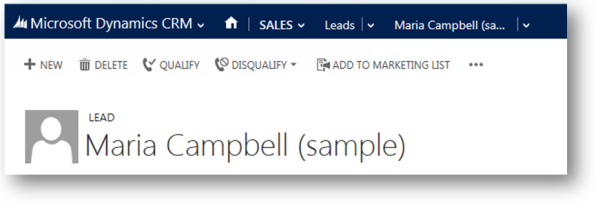
People can choose the default epitome to upload a film from their computer. Images must exist less than 5120 KB and must one of the post-obit formats:
-
jpg
-
jpeg
-
gif
-
tif
-
tiff
-
bmp
-
png
When the image is uploaded, information technology will be converted to a .jpg format and all downloaded images will also use this format. If an animated .gif is uploaded, only the first frame is saved.
When an image is uploaded, information technology will be resized to a maximum size of 144 pixels by 144 pixels. People should resize or ingather the images before they upload them so that they will brandish well using this size. All images are cropped to exist foursquare. If both sides of an prototype are smaller than 144 pixels, the image will be cropped to be a square with the dimensions of the smaller side.
Feedback
Submit and view feedback for
Source: https://docs.microsoft.com/en-us/dynamics365/customerengagement/on-premises/customize/types-of-fields
0 Response to "Field & Stream Mens True Pursuit Insulated Hunting Jacket Reviews"
Postar um comentário