How to Read an Airmap for Drones
What'due south our vector, Victor? —
By mapping the skies, AirMap app paves the mode to a drone-filled futurity
Amazon pushes for federated skies; AirMap gives drone owners a direct line to the tower.
AirMap
The problem with being a safety-conscious, responsible drone operator is that information technology's much easier to actually fly the drone than it is to comply with Federal Aviation Administration (FAA) rules. If we're ever going to have instant Amazon Prime Air deliveries, Domino's Pizza drones, and other flight robot helpers, complying with those rules needs to get easier—it besides needs to get automated.
At the contempo Clan for Unmanned Vehicle Systems International (AUVSI) Xponential conference in New Orleans, Amazon Prime Air Vice President Gur Kimchi outlined Amazon's vision for how that might look. Kimchi and Amazon propose an approach that uses "federated" traffic control—the sharing of information betwixt air traffic control systems, operators, and drones themselves to enable a safer yet more crowded sky. The groundwork for such a organisation is already being laid—in part thanks to software adult past a Santa Monica, California, company called AirMap.
AirMap has released an application for Apple iOS that could make drone operations safer past directly connecting drone operators to drome operators and air traffic controllers. The app is built atop an Cyberspace application interface that is likewise existence used by drone manufacturers like DJI, 3D Robotics, Yuneec, and the commercial and war machine small UAS manufacturer Aeryon Labs. This setup allows users to integrate the same services directly into the software used to fly drones.
AirMap has already brought 75 airports onboard with the application, which gives airport managers a "dashboard" from which they tin grant or withhold permission to wing and set specific automated policies for sure areas near their airports. Eventually, the software volition let drone operators see each other as well every bit information near crewed aircraft on courses that might conflict.
The drone telephone tree
Today, if you want to fly a drone in compliance with FAA rules, it's relatively piece of cake—that is, as long as you lot're flying far from civilization, in visual line of sight, beneath controlled airspace, and nowhere above people or cars. Wing i anywhere else, and things get complicated.
Odds are that in that location'south an FAA-designated airfield near you lot, whether it'due south an actual airport or the helipad at a local hospital. "In 2012," explained AirMap CEO and co-founder Ben Marcus, "congress passed a law—Section 336 of the FAA Modernization and Reform Act—which requires recreational operators of drones to give notice to airports and air traffic command when flight within v miles of an airport. So to give notice, yous would pick up a telephone or knock on the airport director'southward door and say, 'Hey, I'm going to wing over the 7-Xi down the street.'"
Technically, the regulations apply even if you lot're flying a kite. (By the style, if you're flight your kite more than than 150 feet upward without proper lighting, this is also an FAA dominion violation). At the park nearly my house, that means contacting 10 different entities—seven hospitals, a urban center h2o filtration plant, city police headquarters, and a hotel that occasionally allows helicopters to state on the roof of its parking garage. I know this generally considering of an "app" released by the FAA earlier this year chosen B4UFLY, intended to help drone owners become aware of things like temporary flying restrictions and the restricted airspace near airports. But B4UFLY doesn't provide whatsoever way for would-be drone pilots to achieve airports to get permission (not even phone numbers). All the app gives is a breadth and longitude for the location of the airports nearby.
The current organisation of contacting airports also ignores another of import part of drone safety. While the FAA's air traffic control organization may eventually provide information to other organizations, "in the interim there's a whole lot of other public safety entities that take an involvement in drone prophylactic," Marcus explained. He'southward not just referring to airports, but local police and other organizations need to be aware of what's in the air, who's flying it, and where it's flying. Currently at that place's also no easy way for drone operators to know when there's a change in the situation while they're flying—such as an emergency service helicopter barreling into their flight path.
And then while the FAA'southward B4UFLY app and the collaborative programme with AUVSI and the Academy of Model Aeronautics (AMA) that spawned it are giving drone operators some very basic information, they're not exactly making the skies condom on their own. Drone prophylactic, Marcus said, "starts with sensation for operators—giving them something that's easy to sympathize about where they can and can't wing safely, that'southward dynamic. It's similar to the B4UFLY concept, but we asked, 'How do we make that really useful?' That's how we started… we decided to look at how we go nigh building a safe and efficient operating environs for drones. The commencement chemical element of that is awareness. And information technology'due south not just about how y'all display things on a map, only how you get that data into the hands of the operator."
There's an app (and an API) for that
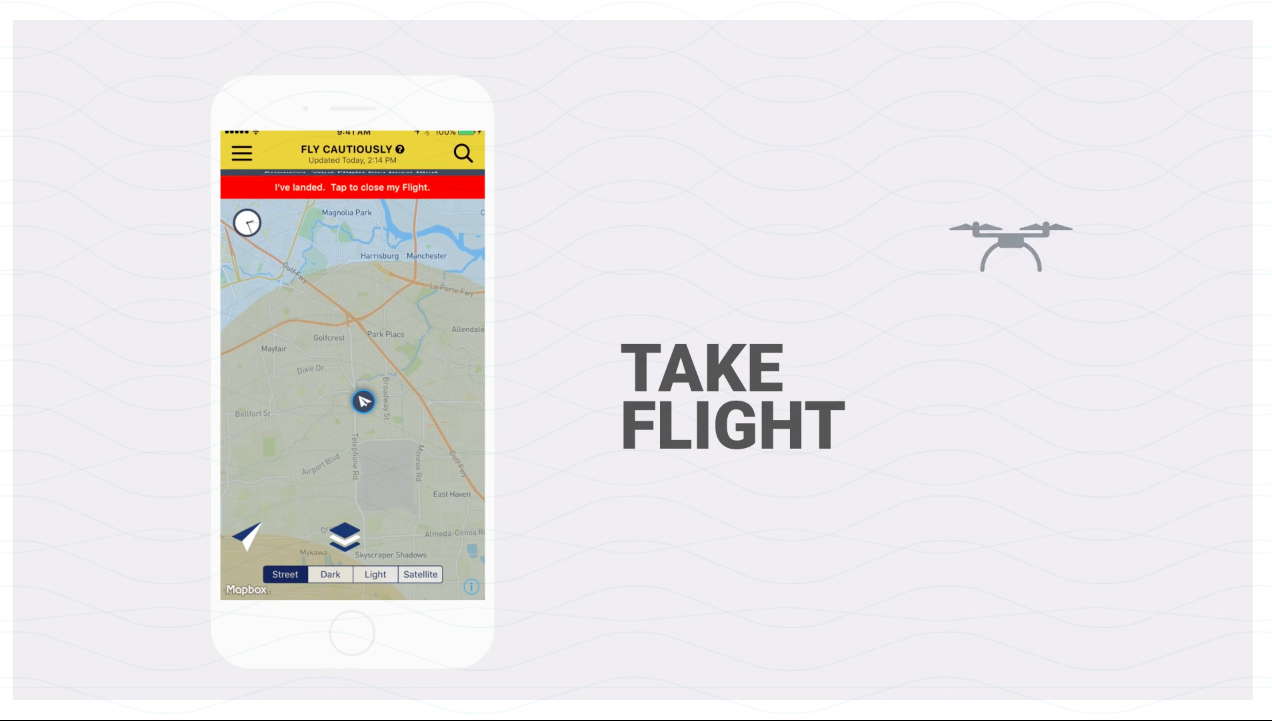
The AirMap iOS application is available on iPhones and also has an Apple tree Sentinel add-on. It allows a drone pilot to create a profile, including a "library" of aircraft and contact information, to be used to transport notifications of flights. The app collects geolocation data, gives a color-coded message about flight restrictions, and offers the drone pilot the power to notify airports within five miles of flight plans just through a tap on the screen.
-
In AirMap for iOS' settings, y'all can choose to share your flying data with other drone operators too as airports.
-
Tapping on the screen to launch a flight plan near an airport...
-
will requite you the tower's telephone number if the airdrome'southward not enrolled in D-NAS.
-
You can likewise upshot the alert from your Apple tree Scout...
-
...and tap "landed" to notify airports when it's over.
-
Of course, there are some places y'all'll probably never be able to wing, even with AirMap.
Everything that's in AirMap's iOS app is also bachelor in the AirMap awarding programming interface and software programmer kit. The goal, Marcus said, is that "y'all don't demand to open another app—you tin come across the data with the app you're already using to fly your drone. So if you lot attempt to take off within five miles of an airport, you get a pop-up bulletin asking if you'd similar to provide observe."
AirMap'southward app for iOS.
On the other end, airport operations centers tin can plug into the AirMap organisation, called the Digital Find and Awareness System (D-NAS). These groups volition use a "dashboard" awarding that allows them to see all of the notifications inside their operating area. "We launched that program with the American Association of Airport Executives recently," Marcus said. In full, 75 airports signed upward equally of the beginning week of May—and more are in the pipeline. The airports already using the arrangement include Los Angeles International, Houston George Bush Intercontinental, Denver International, and a host of regional and small airports. "We're also trying to figure out how to make the dashboard useful for heliports as well—more for the helicopter pilots who are landing than for a tower," Marcus added.
-
The D-NAS dashboard provides a list view of drone flight notifications, with a drill-down on data about the individuals doing the flight.
-
It also provides a map of where all those flights are taking identify. Airport operators can designate areas where they automatically allow or deny flights.
The dashboard gives airport operators "a realtime map of where notices accept been provided" by drone pilots, Marcus explained. "They can likewise, equally the airport operator, click on any of those flights to get information on the type of drone and the altitude it'south flying at, and [they] tin can send an SMS message to the operator from the dash." That SMS message tin be manually typed in or automated.
Additionally, the dashboard allows airdrome managers to set geo-fence-based rules that can automatically set an area as more permissive of drone flights or explicitly exclude drones from flight in the area (such as the arroyo paths being used for landing aircraft). On the drone operator side, that means the SMS messages approving flight tin be used equally a handy way to show law that, yes, they have permission to be flight.
Within the next month, AirMap will add traffic alerts to the iOS app and the API. These alerts are based on aircraft transponder data and other sources, and they will warn drone operators of aircraft that are coming into the airspace they're using. For airports and helipads currently not enrolled in the service, AirMap pulls contact information (including phone numbers) from the FAA'south database—ironically, something the FAA neglected to practise with its ain app.
While AirMap has partnered with specific drone manufacturers, the API is available to anyone building their ain drone. The iOS application (which will be followed shortly by an Android app) is intended largely to demonstrate the features of the API—which includes map tiling and other geo-spatial data independent of what's built into iOS or Android, Marcus said. "The second reason is so that we can allow people who do not have a drone built by one of these manufacturers to also participate in the system—if yous're edifice a drone in your garage or flight something rudimentary, perchance even without GPS—yous can nevertheless participate with the digital notice."
In robots we trust
While the AirMap app addresses operations within line of sight, hereafter drones flight autonomously will need a whole additional layer of communication to operate safely. In particular, these devices will need drone-to-drone communication to help "deconflict" whatever potential collisions in more crowded skies. Again, Kimchi outlined Amazon's proposal for how this would work—a organisation in which services like AirMap would exist part of a larger "federated" traffic control system, providing both rules for general drone traffic flow and automatic alerts and responses to potentially unsafe situations.
These sorts of federated services are something Cyberspace service developers like Amazon are already familiar with. But such setups are currently far outside the FAA'south comfort zone, and this would require a cultural change in how the aviation manufacture views automation.
Kimchi remarked on the irony of how the aviation industry currently uses autopilots to land aircraft in foggy weather condition when pilots can't see the rail, yet they don't trust the systems in proficient weather when the run a risk is lower. "We already trust the automation in the worst possible weather, why don't we trust it the residual of the time?" he told the AUVSI briefing crowd. And so when drones can both sense and avoid hazards and share data amongst themselves most such hazards, organizations similar AirMap and Amazon believe UAVs will be able to wing safely in public airspace—doing so in much greater numbers.
Source: https://arstechnica.com/information-technology/2016/05/by-mapping-the-skies-airmap-app-paves-the-way-to-a-drone-filled-future/
0 Response to "How to Read an Airmap for Drones"
Postar um comentário